This transcript was generated from the audio using an RTX 3060 12GB GPU using WhisperX. The output was then summarised by Ollama and Qwen on the same machine.
Let me know of any significant errors in the summary
The Moodle community meeting involving representatives from MoodleBox, Moodle Japan, and Moodle France. The discussion focuses on project updates, technical challenges, and the role of national associations in research and development (R&D).
Key Discussion Points
1. MoodleBox Synchronization (Bill/Nicholas)
Functionality: Bill discussed the synchronization capabilities of MoodleBox, which can sync student data between a university server and a MoodleBox instance.
Security & API: Currently, it uses REST APIs and tokens built into Moodle. The team is exploring OAuth but acknowledges current security isn’t 100% perfect yet.
Use Cases: Beyond the “MoodleBox” itself, this tool is useful for:
Multiple campuses syncing general education courses.
Creating a “giant sharing cart” where teachers pick and choose activities from a central repository.
Textbook workbook scenarios where users get free Moodles but need to sync specific content.
2. Video Assessment Module (VAM) (Suguru)
Purpose: A plugin allowing for rubric-based assessment of video performances (speeches, nursing skills, etc.).
Tutorials: Suguru created three tutorials to lower the entry barrier for teachers: setting up activities, building rubrics from templates, and reviewing submissions.
Technical Limitation: There are issues with YouTube’s “old dubbing” feature. Languages must be selected before publishing; missing dubs cannot be added later, and copyright flags on background music can prevent dubbing generation.
Future Plan: The team aims to contact approximately 800 Japanese universities to identify needs and share documentation/resources by the end of the year.
3. Role of National Associations (Dan/Harold)
Grassroots R&D: Dan emphasized that long-term commitment from educators at the grassroots level (like Moodle Japan and France) is more effective than top-down assignments from HQ.
Examples: The Video Assessment module has gone through 12-14 iterations yearly, while MoodleBox has improved over 10 years of iteration.
Funding: National associations contribute funding (e.g., 1 million yen to the Quiz Question Bank project) and government ministry funding is utilized for open-source projects.
Next Meeting & Closing
Date: Tuesday, October 27th (approximately four weeks from the current meeting).
Topics: AI and Security. Specifically:
MDL Shield: A tool by Marina Glancy to help make plugin developments more secure using AI.
Google Platform Security: Philip Kropp will discuss securing Google platforms for Moodle admins.
Invitation: The team invites attendees to visit the Moodle Mood Japan conference in Kitakyushu next March (during cherry blossom season).
The meeting concluded with a thank you to all participants and a reminder that slide links were shared in the chat.
Hello, my guest today is one of the most active and influential minds in the field of digital education. He works in Gütersloh and coordinates digitalisation there, but he is also a co-founder of the Institute for Contemporary Assessment Cultures. At the same time, he is an entrepreneur, a real jack-of-all-trades, and he built the tool FellowFish, which is now being used in schools all over the country. He also hosts a podcast called Kompass KI together with school psychologist Benedikt Wisniewski, which they record regularly. There, they dissect the latest studies from the world of education and AI. I can warmly recommend that everyone listen to the podcast as well.
So here, specialist knowledge comes together with classroom experience and technical understanding. That is genuinely rare. I’m very pleased that you’ve taken the time.
Hello, Mr Haverkamp.
Yes, thank you very much for having me.
This week has been very much dominated by the PISA study. Let me ask you quite openly: what was your reaction to it?
It feels a little bit like Groundhog Day. For decades now, we have essentially had it documented that the German school system apparently does not prepare students optimally, and that the German school system has largely fallen behind internationally.
So the results were not particularly surprising. It was also not surprising that the media coverage of the PISA study essentially lasted for one day and then disappeared again.
Unfortunately, education does not have a high priority and does not have a particularly strong lobby. And that is actually what made me especially sad — naturally, in addition to the poor performance of students in mathematics and science, but also in reading.
And then, almost reflexively, you would often hear the sort of pub-talk explanation: “Well, of course. That’s what happens when they spend all day messing around on their phones.”
How would you respond to that?
Well, those are obviously the simplest explanations that people reach for: COVID, or smartphone use. But if you look at it, these are global phenomena, of course. The question is: why does this have such a dramatic impact specifically in Germany?
I think there are many other factors that come together, and some of them are very characteristic of the German school system and are handled differently internationally.
I think that explanation is too simplistic. Of course, it will have an influence. But it is only one facet among many that ultimately result in these poor levels of achievement.
Yes, above all we have this enormous spread. We have a great deal of educational inequality. And the data very clearly show that we are really leaving disadvantaged children behind.
That is serious for an economy and for society as a whole, in many different respects.
So let’s move a little into the world of AI.
The great hope is surely that artificial intelligence could allow us to individualise the learning experience in a way that we have never been able to do before. So not everyone has to learn at the same pace or receive exactly the same stimulus, but instead each student gets the lesson or support they need at that particular moment.
Perhaps even at the appropriate level of German, perhaps occasionally with help from another foreign language.
Do you see hope there?
That is, of course, the great promise of AI: to create personalised and individualised learning environments that fit each student.
But it is still a very difficult field, because that is only one aspect of teaching. Teaching is extremely diverse. There is a great deal of relationship-building involved. Conversation is important. And I think these extreme examples, where students essentially receive their individualised curriculum at the beginning of the day and then work through it by themselves, are not how school is conceived in Germany.
And that is not how school works either.
Learning is, of course, also a collaborative process. You can be inspired by your classmates. And the teacher is still a very important figure.
So I think it comes down to having the right mixture.
With AI, just as with any other tool, you can make very good teaching even better, but you can also make very bad teaching even worse.
So in a way, it is an amplifier of our behaviour.
And therefore you cannot really say that AI inherently makes teaching better.
What you can say fairly confidently is that it does not.
The question is: what should teaching look like under the conditions created by AI so that it actually promotes learning and so that as many students as possible can benefit from it?
Yes, tell me. I’m all ears.
Well, if we had a universal solution, that would obviously be wonderful.
I think we are still in this phase of experimenting and seeing how it can actually work.
The most important thing, I think, is to realise that AI is here to stay. It is not going to disappear.
And schools have to adapt to the fact that we now suddenly have an additional player in the classroom that is thoroughly disrupting the old way of doing things.
For decades, even centuries, we were simply accustomed to being able to infer students’ competencies from a written text.
That no longer works in the same way.
We can assume that, essentially, all texts that students write outside school may have been produced in co-authorship with AI.
And therefore, I think we have to find different teaching environments where we do not want to exclude AI.
There obviously also needs to be a phase in which students learn without AI.
But we also need to consciously integrate it, so that children and young people learn how to use AI sensibly.
They need to learn to distinguish when the right time is to use AI — and when the right time is to complete a task without AI.
It is a little bit like Peter Lustig used to say at the end of Löwenzahn: “Please switch off.”
And then you would switch off the television.
In the same way, we have to teach students where AI is wanted and where it is not.
Schools need to formulate rules for this.
And students actually want rules to be established, because they do not want to constantly be accused of doing everything with AI.
They want to know: When is AI useful? And when are we not allowed to use it?
That would also make this cat-and-mouse game disappear.
It is always a little like that. When this watermark was announced, teachers were already rubbing their hands together.
But of course there is also the possibility of removing the watermark very easily again.
And if there are experts in that area, they are certainly our students.
That means we definitely need to rethink the culture of assignments.
We need different assignments.
We also need to rethink the learning culture.
And we need to rethink the assessment culture.
Those are three enormous construction sites.
And all of that comes on top of the other challenges that schools already face.
So it is a Herculean task, and certainly not something that can be solved within a year with a single concept.
Yes, you are touching on a lot there.
First of all, we are hearing that there could be a kind of Matthew effect.
The weaker students will probably become even weaker because they will have these tasks done for them, especially at home.
But perhaps even in their term grades.
I have already heard about this. Students are clever, as you say.
They take a photo of the worksheet, get the model answer, put their hand up, and essentially become ChatGPT’s parrot, briefly repeating what it has said.
Then there are the good students, who perhaps have intrinsic motivation, perhaps come from a different family background, and who actually use AI to expand their own competencies.
And then there is also the Matthew effect applied to teachers.
I found that particularly interesting.
The good teachers who create lessons that perhaps appeal to the majority of students in the classroom and are engaging — those are probably the teachers who will also make better use of AI.
And then there are other teachers who find it more difficult.
How do you make sure that the entire teaching staff benefits from it?
Because it is difficult. We have very different generations. We have different levels of technological affinity in general.
How do you manage this in practice — through guidance, workshops?
What do you actually do in your school to get the whole staff on board and to create the feeling that this cat-and-mouse game is somehow coming to an end, so that people feel competent on both sides when dealing with AI?
Yes, absolutely.
Teachers complain about heterogeneity, but the greatest heterogeneity in the field of AI can be found in the staff room.
The experiences range enormously.
There are teachers who have never entered a prompt, and others who have built their own agents.
We tried to develop an AI concept for our school.
And it was very important that we did this together with the students, because ultimately they are the ones most affected by it.
We then considered: what rules should apply in our school? And what is our position on artificial intelligence?
I come from a very digitally minded school.
We have a headteacher who was head of the German School in Silicon Valley several years ago and came back to Germany with a very AI-friendly attitude, saying that we had to engage with this issue.
That was before ChatGPT was introduced.
So we started dealing with AI very early on, meaning that it wasn’t a huge shock when ChatGPT suddenly appeared on the scene.
But we also asked our students: How are you actually using it?
Two months after ChatGPT was introduced, 80 percent of the students already knew about it.
And many already had their own account.
If you ask them three years later, 100 percent of the students have access to these tools.
So it was clear that we had to deal with it somehow.
The guidance documents from the German federal states are helpful.
They came relatively quickly because ministries also understood that this would have a massive impact on schools.
But of course it is not enough simply to publish a guidance document.
They become outdated incredibly quickly.
So I think schools have to set out on this journey themselves and ask:
What rules should apply here?
Which tools do we actually want to purchase?
In which teaching environments does AI promote learning?
At our school, we therefore actually plan lessons together and consider where we want AI and where we want less AI.
In Years 5 and 6, the focus is primarily on developing basic skills.
You can also do that with AI, but it is used very selectively there.
In the higher year groups, it is used quite frequently, but always critically and constructively.
The question is: Is this actually necessary? Is it useful?
And above all, we look at the results and check them.
We try to teach students that they do not need to know less; they actually need to know more.
They have to compare the AI output with their own subject knowledge and check whether there might be hallucinations, what the bias looks like, and whether the result can actually be used.
We also teach students that they are responsible when they use AI-generated content.
They are ultimately responsible for its accuracy.
You cannot say, “Well, the AI produced it. I just used it.”
That doesn’t work.
We try to convince our students and young people to take responsibility for what they use.
And at the same time, if I understand you correctly, you are still advocating for certain screen-free islands where students can learn completely free from these tools, using very old-fashioned analogue methods.
That brings me back to the question of the “calculator moment”.
Could you explain what you mean by that?
Yes.
Probably about 30 years ago, when calculators entered schools, people also felt that mathematical basic skills and mental arithmetic were going to disappear, and that it was the end of Western civilisation.
But mathematics found a very clever solution.
There are phases where the calculator is introduced, and that does not happen in Year 1. It usually happens in secondary school.
And even in exams, there are sections where no aids are allowed, where I have to demonstrate that I can access those basic skills without technological assistance.
And language subjects are now experiencing that calculator moment.
Because ChatGPT and similar systems are capable of producing essentially any text at the push of a button, this is somewhat analogous to the moment mathematics experienced several decades ago.
And now the language subjects also have to find a sensible way of dealing with it.
It has become clear that mathematical competencies are different.
Perhaps we can now aim for higher-level competencies because certain calculations can be outsourced to the calculator.
And that is now the question:
Because text-generating AI can produce any text, can we perhaps use that to target and teach higher-order competencies in students?
That is the major question we now have to deal with.
Does AI mean that students learn better, or does it hinder learning?
We have already talked about the Matthew effect.
And in Germany we already have — we started with the PISA study — this enormous divergence between students.
There was already a massive effect in Germany where students from educationally disadvantaged or poorer families clearly do not have the same conditions as students from wealthy and privileged academic families.
And AI is now making that divergence even greater.
We have academic parents who pay for the professional tools for their children. Some of them are genuinely spending $100 or more a month so that their children have access to the best AI tools.
And then we have children who can use, at most, the free versions.
You can see how the gap is getting wider there as well.
We have financially strong families who can afford to provide their children with the best tools.
And on the other side, we have children who are not practised in using them, who perhaps receive no support at home, and who do not have access to the tools.
That is naturally something that concerns us.
And therefore, I think it makes sense for schools to consider which tools they want to purchase.
And, of course, something like IS-Chat should become available in all schools.
There are many other tools you could name that could provide this basic infrastructure — whether it is a general chatbot or image generation.
So I think it is sensible to consider how we can prevent the educational divide from becoming even wider because of AI.
It is already problematic.
Now we have to find a way to bring people back together.
Let’s talk a little more about the calculator.
I think it is a great analogy, actually.
But it only goes so far.
Because even with a calculator, I still can’t solve, for example, a word problem.
Sure, if I simply have a calculation and can type it in, that is a very simple task to solve with a calculator.
But AI tools can perform all the intermediate steps as well.
It can essentially complete the entire task.
And nowadays the kinds of tasks it can handle are virtually unlimited.
At first, we talked a lot about what kinds of tasks you could give students that AI simply could not solve yet.
And by now, I think we have reached the point where — yesterday, apparently, an AI solved one of the Millennium Prize Problems in mathematics, potentially with some human assistance beforehand.
That makes quite a difference.
And then I see a gigantic confidence crisis.
People no longer trust themselves.
I had a classmate who was actually a really good mathematician, very clever, who got great grades in mathematics in upper secondary school.
But I was sitting next to her during the Abitur, and she entered things like two times seven into the calculator during the exam because she did not trust herself.
She felt she had better check again, just to make sure nothing went wrong at that level.
I am seeing something similar happening with language now.
Students — or, in my case, university students — when they write emails to professors, there isn’t a single email that they don’t have checked again.
And I think there is a difference.
We are not mathematical formulas, but we are the language we speak.
We are not much more than what we tell ourselves and what we tell others.
So it touches something much closer to us.
We identify with what we say.
And if suddenly everything that currently reaches the outside world digitally, or at least in written form, is mediated through AI, what happens there?
Isn’t that actually different?
Yes.
These metaphors you mentioned — the calculator moment or the stochastic parrot — are naturally metaphors that come from that first phase, when the models were not nearly as powerful as they are now.
And nowadays they can, of course, handle all these intermediate steps.
They can solve mathematical problems that have remained unsolved for decades.
So the question is whether the term “stochastic parrot” is even still legitimate.
Or has it now reached the point where AI is producing things that we did not put into it?
That is a really fascinating moment, because the question is whether this represents the next stage of development.
And I completely agree with you.
The calculator moment and the stochastic parrot were metaphors that had their justification around 2023 and 2024.
But nowadays these systems can generate all the intermediate steps, reflections, and so on.
A model can generate those for me, so I am no longer dependent on doing them myself.
And yes, I also think that in many cases this leads to students becoming less independent.
We then have to bring them back into phases where we work without AI and, essentially, make them use the tools that we as humans have — to think, reflect, and perhaps write an email without AI again.
So I completely agree with you.
That is a major problem.
On the one hand, students have a tool that enables them to be incredibly productive and create new things.
But on the other hand, it is also a kind of sweet poison that tempts us to have everything checked again in the end.
So yes, I agree.
The question is how we respond to it.
I think we need phases in which students work without AI, and work phases in which they work with AI.
Then we need to reflect.
As I said, was using AI necessary and useful in this case?
Where is it useful to trust our own abilities and competencies?
I think we are currently in a phase where everything is still fluid, where teachers themselves have to experiment and see how they should work with their students.
There are no finished teaching concepts for this yet.
Teachers first have to train themselves and figure out how to deal with these challenges.
You have built a tool, FellowFish, which is intended to make at least part of teachers’ work easier — the tedious tasks.
Could you briefly explain what it is for everyone who has never heard of it?
FellowFish.
A short pitch.
A short pitch.
FellowFish is an AI writing companion for students that can provide personalised feedback during the writing process.
Teachers create an assignment that requires a text-based response.
The students work on the task and can request feedback at any time.
The feedback is generated according to specific criteria.
The teacher has previously defined those feedback criteria.
The language model behind it then compares the student’s response with the criteria, the learning material and the assignment, and provides the student with feedback that supports learning.
The second part is that the feedback works in both directions.
Teachers also receive feedback.
The students’ competency levels are presented in a teacher dashboard, so I can see which student struggled with which criterion and where they had problems.
Where do I perhaps need to intervene again?
This gives me, as a teacher, a way to receive data-driven feedback in real time about where my students still need help.
Previously, that simply wasn’t possible.
If I have 28 children and young people sitting in front of me, I might be able to read two texts.
But I have absolutely no idea what 90 percent of the class did or how they did it.
That is the problem we are trying to solve with FellowFish: providing feedback to both students and teachers.
Let me ask you this.
It sounds incredible at first, but aren’t you essentially one of the people working towards making your own profession obsolete?
No, not at all.
I am genuinely a teacher at heart, and I would say no.
But it may relieve me in the sense that it gives me the opportunity to provide every child and young person with feedback in principle.
That is something I simply could not do before.
And that is tragic, because I know that feedback can be incredibly effective for learning if it is done properly.
But I could never really offer it to everyone.
Now, for the first time, I have the opportunity as a teacher to offer it to everyone.
And because I can then see through the analysis page which children are actually struggling, I can focus particularly on the people who really need my help.
So for me, learning becomes visible and transparent, and I can use the capacity that has been freed up for the students who really need my help.
I simply didn’t know that before.
And I can also talk to the students.
I can see which error patterns dominate in the class and then say:
“Hey everyone, I think a lot of you still haven’t understood how to write an introductory sentence for an analysis. Let’s look at that together again.”
For me, it is simply the opportunity to adapt my teaching live and dynamically and respond much more strongly to the students’ needs.
So I don’t use the time to sit at the front and read.
I use it to look at the dashboard and see: Who is actually struggling here?
And then I can approach specific students and say, “Hey, shall we take another look at this?”
And for me, it is a wonderful feeling that the people who really need my help can now actually receive my help.
So we can hope that AI will ultimately free up time for relationship-building, if we want to put it in those abstract terms.
That would really be my hope.
Yes, because on the other hand we can also see that we are extremely vulnerable in that relationship-building process to simply relying on AI.
I was recently talking to someone who said that perhaps the riskiest profession you can choose at the moment is therapist, because of AI’s sycophancy — the way it interacts with us, how deeply it already understands what makes us who we are, and how it can offer us a kind of relationship that we may not be able to have with any other human being.
Yes, on the one hand that’s true.
But on the other hand, I still see enormous differences there.
If I walk over to a student and they show me what they’ve done, and I pat them on the shoulder or we high-five and I say, “You did that really well,” AI can’t do that.
That human interaction, that empathy, the fact that I can communicate enthusiasm or disapproval to a student through my gestures, facial expressions, and genuine excitement — that authentic experience of thinking together in the classroom, sitting together and wrestling with problems together — AI does not take that away from us.
And at that point, it is not a replacement for me.
And that is what students want.
They want recognition from their teacher, from a real human being.
It is all very well that they can perhaps move their progress bar from red to green and see, “Hey, I’ve actually improved.”
But students want to be seen by a human being, by a human teacher.
They want my warm words.
They want my encouragement.
Sometimes they also want my consolation.
And I don’t think AI can provide that yet.
And I think that is why the teaching profession will not disappear.
Teachers are, I believe, indispensable for that.
Yes, that gives us a lot of hope.
Does it also have a lot to do with embodiment?
The fact that you actually possess a body.
Learning often hurts.
My idea is that AI really cannot imitate that.
The idea that we have walked the same path, that I am not smarter but simply further along.
I am older.
Yes.
But I sat there too.
At some point I also had back pain while preparing for my Abitur.
At some point your finger hurts when you’ve been writing that much.
Yes.
And that physical experience — being able to reflect it back and say, “Okay, you can identify with me; I’ve been through this too” — that is perhaps the most wonderful thing when a teacher can genuinely be a role model in that way.
Yes.
That is another area where I think a kind of limitation game is perhaps still appropriate.
There are things you simply cannot do.
Yes.
It was also interesting when these bots emerged that sites such as Rent-A-Human appeared almost immediately, where AI agents could supposedly hire humans for that final mile — exactly what you have just described.
That turned out relatively quickly to be somewhat of a fake.
But I think that is naturally the remaining gap between humans and machines.
And we probably still have a few years in which we can focus on developing and strengthening these relationships with students.
Coming back to the feedback component, where you are more entrepreneurial but also deal with it every day as a teacher:
Here is an open question.
Do you feel that you can compete with the giants from Silicon Valley?
Can your product keep up with them?
Yes.
Definitely.
Because we cooperate closely with feedback research.
We have our own scientific advisory board, which includes two feedback researchers.
We have the IPN in Kiel as a scientific cooperation partner, and they also use FellowFish in their studies, for example.
And I think we also have this close connection to schools through me.
We have various other pilot schools that continually receive additional features and can test them.
So we are trying to occupy a niche that is not particularly interesting to the large, general-purpose language models.
And we are trying to serve that niche extremely well and in a scientifically grounded way.
I think it is difficult for these generalists to provide truly tailored feedback.
We have 16 federal states in Germany, and in each federal state there are around ten different types of schools and different curricula and syllabuses, plus 16 or even 20 subjects, sometimes at basic and advanced course level.
The German school system is so differentiated that I think the big generalists will always have the problem that it is so niche that it simply isn’t worth it for them to become deeply involved.
That is more or less what we see.
We are trying to make it extremely science-driven while remaining in this niche.
And our focus is exclusively on feedback.
We don’t want to correct teachers’ work.
We are not conventional learning platforms.
Other companies can do those things.
Our focus is exclusively feedback.
And we want to do that extraordinarily well.
Yes, that sounds like a good business model.
I’d like to add a little anecdotal story.
I have just completed my PhD.
Yes, I’m only telling this because I need it for my story.
Shortly before my defence, I gave my dissertation to ChatGPT and thought, “Okay, I’ll prepare a little. What kinds of questions might I get?”
All I got back was hallucinated nonsense.
That was in February of this year.
And honestly, I thought it was pretty cool.
I thought, “Okay, apparently this is at a level the AI hasn’t understood yet.”
That was a bit of a moment for me where I thought, “Yes, okay.”
I did the same thing three weeks ago with Anthropic and asked it to give me feedback on the dissertation.
It is quite long — several hundred pages.
And it was unbelievable.
There were layers of meaning in it that I know no other human would understand.
But on page 17 I had built a small metaphor, and then I continued developing it again on page 467.
And this other entity tells me:
“Wow, cool. I noticed that.”
And that gave me goosebumps.
I realised, “Okay, there is a second entity that understood this work in this way.”
Then you look further and of course it gives you an incredible number of tips about spelling and grammar.
There were still so many mistakes in it after submission.
But perhaps you should also show a little humility and watch this with the students.
Even a doctoral thesis is still full of tiny spelling mistakes.
That hurt my feelings.
It felt like my first kickboxing lesson, where I was 14 years old and trying to spar with a black belt who weighed 40 kilos more than me.
Every punch I tried, he immediately pointed out:
“Here, your defence is open. You should do this here. And look, here…”
And essentially he showed me the whole time:
“You actually can’t do anything yet. Stand at the back, take it slowly, and we’ll talk again in 20 years.”
But in 20 years, my kickboxing instructor might have a slipped disc or something else might happen, while AI will be even better in 20 years.
And those are the kinds of moments I think we’re all experiencing with AI right now.
Yes, it’s an asshole.
I think we’re going to have to get used to it.
Because the interesting thing about that feeling of humiliation is that we have actually been experiencing it for centuries.
In the physical realm, machines have long been vastly superior to us.
A car drives much faster than a human, but I wouldn’t feel humiliated if my car suddenly raced past me.
But when it comes to intellectual abilities, we perceive it very differently.
Apparently, we experience that as an insult.
Yes, but again, it is similar to what you said about numbers.
We are not the race itself, but we are often the language.
We identify with it, don’t we?
Yes.
This is certainly a fascinating moment — feeling humiliated because there is, as you said, a second entity that apparently sees things in the same way or understands the subject just as well, even though I would see myself as an absolute expert.
And with a dissertation, I assume that is the case.
That really is a goosebumps moment.
I experienced something similar recently.
I thought, “This is completely crazy. It noticed this.”
I gave it access to my FellowFish account through an MCP, and asked it to create an assignment for me.
It then looked through all my existing assignments and said:
“You already have an assignment here. You could redesign it, and then it would fit perfectly with the topic.”
And I thought, “Wow. That’s true.”
I wouldn’t have thought of that.
That is such a clever idea.
And I had actually put the assignment there myself.
I think we are going to have to get used to this happening more and more often.
You also believe that we need more possible forms of assessment.
I’d like to talk about that as well — what an appropriate assessment culture might look like under these conditions.
Yes.
That naturally connects to the beginning of our conversation, where I said that we can no longer infer students’ competencies from a written text.
What we are currently experiencing is that certain forms of assessment are coming under enormous pressure.
The Standing Scientific Commission, or SWK, and the Standing Conference of the Ministers of Education and Cultural Affairs, the KMK, have already formulated consequences, such as the idea that research papers or seminar papers written at home should be abolished.
Those were actually some of the most sensible formats we had.
And we are now moving away from them.
Because precisely this is no longer possible.
We can no longer establish authorship with certainty.
So we have to think about what an assessment culture might look like under the conditions of AI.
You quickly arrive at oral examinations, because you can ask children and young people to explain the texts they have written or to describe particular facts.
And then, supposedly, we have an authentic picture of what students actually know.
Of course, there are two major problems with oral examinations.
One is scalability.
I think that is an even bigger problem at university than at school.
If I have a lecture with 500 people, I can’t offer oral examinations.
But schools have this problem too.
And people naturally point out that we might then primarily be testing students’ ability to express themselves orally.
Although you could counter that by saying: until now, written exams have primarily tested written expression.
Perhaps it is fair now to put more emphasis on the other horse — oral examinations.
But I find another idea much more interesting.
The question is: if we can use tools such as FellowFish to document students’ competency levels in every lesson, why do I actually need to give an examination at all?
If students can demonstrate and document in class that they have already acquired a particular skill, why do I need to give them another written exam that makes life difficult for me as a teacher?
We have the most wonderful profession in the world if it weren’t for these soul-destroying exams.
Having to read the same type of text 25 times is one of the most awful things.
So that would be fantastic.
Benedikt Wisniewski and I wrote an article for the Schulportal about this.
Two hundred million working hours are spent every year on marking.
What could we do with that time that would actually be useful?
I think again about relationship-building, or about learning.
And I think we need to assess much less.
Of course, we will still need examinations.
Schools have an allocation function, after all.
And examinations are naturally important for qualifications.
But I think we need to focus much more strongly on the learning process and accompany it closely.
AI can also help us analyse that and give us feedback.
Where are my students right now?
And we should assess much less.
That would essentially be my answer.
Oral examinations are all well and good, and they certainly allow me to assess an individual student’s performance.
But perhaps we simply don’t need as many examinations as we think we do.
And it varies enormously.
It is also interesting that the number of class tests and examinations in upper secondary school varies massively between the federal states.
In some states, students take only 20 to 30 examinations during upper secondary school, while in others it is 60 to 80.
And I think that if we could achieve some standardisation and, above all, a reduction — a process of de-implementation, as Benedikt Wisniewski would say — I think everyone would benefit.
More learning time.
More time for relationship-building.
More learning-supportive feedback.
And that perhaps connects back to the PISA results.
We need to accompany students much more closely in their learning.
We need to identify learning deficits.
And after a test, we cannot simply carry on.
If there are gaps, we have to close them before moving forward with our children and young people.
And I don’t think we can do that particularly well with an assessment culture based on occasional summative tests every six weeks.
So I think it would make sense to think about other forms of performance assessment and learning culture.
Yes.
I think school is a fascinating organisation because it carries so much institutional baggage.
Nobody really knows exactly why things developed this way, but now it is simply considered normal that you have six subjects a day, that you learn for 45 minutes at a time, and all these other things.
And intellectuals keep coming along and saying, “Okay, we need to change all of this.”
I think we have really reached a point where many people are saying, “Okay, we need to experiment more.”
And now there is a two-part question.
First, I am a little concerned that if we introduce very granular assessment systems that essentially give students grades every day and then use those over time to generate an overall grade — perhaps making assessment more detailed and potentially fairer — don’t we risk losing some of the spirit of discovery?
The feeling that students are unobserved.
That they are learning out of their own motivation, without a grade hanging over them.
Doesn’t that turn school into something like a panopticon?
That’s the first part.
And the second part concerns this willingness to experiment, which might actually be helpful in the age of AI.
What is your general view of Germany’s federal education system?
You have just talked about standardisation.
But perhaps there is also a strength in saying:
“Okay, let’s try 16 different models in the 16 federal states, compare them with one another, keep exchanging ideas, and show each other what worked and what didn’t.”
Yes.
Perhaps to address the last thing you said first:
That is naturally the idea behind federalism — that the best ideas prevail and are then adopted by the other federal states.
In reality, it only works semi-well, you could say.
We obviously also have very different financial resources in the individual federal states.
Last year, for example, Bavaria had this BD&KI budget, where schools had their own pot of money that they could spend.
In other federal states, there was a budget freeze and schools essentially couldn’t do anything.
So these federal states cannot really benefit from one another or copy one another because the conditions are completely different.
Theoretically, I would say it is a great idea.
Practically, there are many, many problems.
Now, of course, there are programmes such as the Startchancen programme and other funding pots provided by the federal government.
But those are again aimed only at certain schools.
Approximately ten percent of schools in Germany can access the Startchancen budget.
So we simply have an enormous patchwork.
And while that may be useful for some decisions, over the past years and decades it has also become a real obstacle.
I would like to see a discussion about whether, in many areas, it would make complete sense for one authority to set the direction and for the federal states to follow it much more closely than they have in the past.
I think that makes sense, especially when it comes to promoting basic skills.
All federal states essentially have the same problem.
Whether it is Bremen or Bavaria, why does every federal state have to develop its own funding programme again?
Why can’t we roll out one scientifically evaluated programme, as is done in many of the countries that perform well in PISA?
There, a standardised concept is tested and scientifically evaluated.
Why do we have to create 16 different concepts again?
We already saw this with the AI guidance documents.
Sixteen federal states produced 16 AI guidance documents, even though they essentially all contain the same things.
Why can’t we standardise that?
And I am a big fan of perhaps outsourcing certain things to the federal government again and saying:
“Okay, this is now going to be done in all federal states.”
Rather than every school and every federal state having to develop its own concept.
Okay.
And the first part of the question, about everyday life in the surveillance state of school.
Yes, that is obviously also a very important issue.
We need to think about this.
In schools, there are various tests and examinations.
There is VERA 8, for example, a central examination after Year 10, and the Abitur.
So, essentially, every two to four years we have central assessments of learning levels in German schools.
And an enormous amount happens in between.
And during that time, we are essentially blind.
The point is not to make every student completely transparent and require them to prove every day what they can or cannot do.
Rather, I think it is about perhaps reducing those intervals or introducing regular assessments of learning progress between the major assessments.
The goal would not be to give a grade.
The goal would be to tell the student:
“Look, you’re still struggling with this and that, and now we need to do this so that you can close that gap.”
The focus is very clearly on support.
If you ask me, for example, how often I actually use my own tool in class, it is not the case that I use FellowFish every day.
Sometimes I don’t use it at all for two weeks with a particular group.
I choose tasks where it would be interesting for me as a teacher to find out what they have actually learned.
Or sometimes I use it at the beginning to find out what the baseline is — what do they already know and what can I build on?
It is not about monitoring students 24/7.
That is, I think, a dystopia that we also see in Chinese schools and reject.
It is about sensibly filling the gaps between these major assessments of learning progress so that I can support students as effectively as possible.
Yes.
There is also a second argument for this.
As far as I understand it, there is research in neurobiology suggesting that early testing increases neuroplasticity.
You might feel that you know something — the illusion of knowledge — if you simply sit back and listen to a sequence of lectures, perhaps even enjoying it.
But you retain significantly less than if you test newly acquired knowledge as early as possible and make mistakes.
So perhaps we also need a different idea of what tests and examinations are actually for.
They are not only for evaluation.
They are also for learning itself.
Yes.
And it is crazy that everyone knows how beneficial mistakes can be for learning, while mistakes in school are always treated as something negative.
“Try not to make mistakes, because you might get a bad grade.”
That is crazy.
We should actually encourage students to make mistakes and then learn from them.
And we should look at the fact that perhaps it wasn’t just one student who made the mistake.
Maybe there are systematic misconceptions throughout the entire class.
And that is where we need to intervene.
For example, a tool like FellowFish helps me identify these misconceptions and say:
“Ah, okay. It seems that lots of people have misunderstood this.”
I don’t use FellowFish to give grades at all.
I use it to provide feedback and then work together with students on specific deficits they have.
The process then always goes from individual work in FellowFish back into the whole-class setting.
We might look at the feedback together again and ask:
“Okay, does this make sense? What could we add?”
And what does this mean for the class?
Where are there systematic misconceptions?
A tool like this is incredibly useful for me in that respect.
We’re slowly coming to the end, but I have one more question.
Okay, so we need a different culture around mistakes.
But what about teachers?
Do you already see the problem of epistemic authority — the authority teachers have traditionally had, even beyond the classroom — being undermined?
I’ve heard of some early cases where, for example, parents come to parent-teacher meetings and say:
“We had this checked by this AI and that AI, and the grade is wrong. Our child actually deserved a better grade.”
That’s one level: the question of assessment.
And then there are factual questions.
None of us can know everything in our own subject area.
You cannot plan for everything that will happen in a lesson.
And sometimes our knowledge is outdated.
We have colleagues who studied 40 years ago, and it is perfectly normal that they cannot reproduce every aspect of today’s state of knowledge.
How should we deal with that?
What does it change about the relationship between teachers and children, and then also about the triangle involving parents?
Yes, it is very interesting.
We are seeing this happening in all kinds of areas.
People are apparently now able to draft legal texts, and courts are being flooded with them.
And as a teacher, you suddenly receive texts from parents or students and think:
“Yes, Claude or whoever probably just wrote that.”
I actually think that is wonderful.
It leads to a kind of democratisation, and it encourages dialogue.
If it became excessive and I suddenly received 20 emails a day like that, that would probably annoy and overwhelm me.
But that is not the case.
And I simply think it is wonderful that students are now recognising, as you described, that teachers are only human.
Teachers have a certain advantage in knowledge, but they are not omniscient.
And that is okay.
I am always amazed when students bring their own knowledge into lessons.
I find it incredibly enriching, and I am always happy when they sometimes know more than I do.
We currently have a very interesting teaching unit called “Language, Thinking, Reality”.
We have many students whose first language is not German.
They constantly bring in wonderful examples.
And I always think:
“I can’t do that. I don’t speak Arabic. I don’t speak Kurdish. My French isn’t that good.”
But it is fantastic when they jump in and say:
“Yes, I have another example from Arabic.”
I genuinely love that.
I know that some colleagues might find it a little strange.
But perhaps this is also encouraging a shift where we say:
“Hey, we are human beings too. And isn’t it fantastic if I can learn something from my students?”
Especially in the area of AI, students often show me things that I myself, despite being quite deeply involved in the subject, have never seen before.
And I think:
“This is completely crazy. How can you even do that?”
I think we need to move away a little from the idea that we have to be able to do everything.
It makes us more approachable, more authentic, and much more accepted by students if we don’t try to get everything perfect all the time.
Okay.
So we shouldn’t cling rigidly to epistemic authority.
It all sounds very exciting.
Honestly, listening to you talk about all this makes me want to become a student again myself.
Thank you very, very much for taking the time today.
You’ve given us a great deal to think about, and I hope we can do this again sometime.
AI Summary: (let me know of any errors, usual AI cautions apply) Moodle Developer Meeting — Public Chat Summary Source: BigBlueButton session, moodle.org (id=8596) Captured: 2026-09-15, 11:26 AM – 12:31 PM (session end)
Opening (11:26–11:38 AM) Attendees greeted each other from around world (Japan, Perth, Bavaria, Sabadell, Winterthur, etc.). Andrew Lyons opened as presenter.
Code review / CLR queue discussion (11:40–11:53 AM) Main topic: delays in Moodle’s code review process.
Daniel Ziegenberg asked for stats split by “MoodleHQ Dev” vs “community dev” issues.
Marina Glancy and Alexander Bias flagged CLR (code review queue stage) as where issues get stuck.
Philipp Memmel argued “average” is misleading — core team issues get reviewed almost instantly, community fixes can wait indefinitely.
Neill Magill: found issues waiting over a year for review.
Alexander Bias: wants visibility into queue position (“you are at position x”).
Marie Achour clarified there’s no formal queue, just work items tagged by status; acknowledged community devs experience it as a queue since they’re blocked waiting.
Data point: average elapsed time ~66.9 days (Integration path) vs ~64.3 days (CLR path) — roughly similar.
Philipp referenced a past comment by Tim Hunt (Zurich): problem isn’t prioritization, it’s having a queue at all.
Side chatter (11:44–11:46 AM) Audio issue noted — Scott’s mic rubbing/static.
Wrap-up topics (11:58 AM–12:02 PM)
Don Hinkelman: supportive of folding R&D into HQ dev process rather than separate lab; sees growing role for national Moodle associations (access to government/education funding) — cites Question Bank consortium as a model.
Luca Bösch: offered contact for Quiz/Question Bank topics (luca.boesch@bfh.ch).
Adam Jenkins: expects “MAJ” to pick up leadership of a project.
Communication tone discussion (12:04–12:16 PM)
– Marcus Green raised the importance of positive tone, citing Mary Cooch (former HQ employee) as a model. Well received (9× 👍).
Alexander Bias agreed but cautioned written communication loses emotional nuance, and community actors sound demanding/snippy while just trying to get things done.
Gemma Lesterhuis added that non-native English speakers can be misread as negative/harsh unintentionally.
Marie Achour agreed, noting many community members aren’t native English speakers.
Open Q&A with HQ (12:16–12:27 PM)
Neill Magill: asked what’s the most important upcoming change devs should know about.
Travis Windsor: shared roadmap link (https://moodledev.io/general/community/roadmap) and Technical PAG course link (https://moodle.org/course/view.php?id=17257).
Philipp Memmel: raised concern about AI agent activity in the tracker using Matt Porritt’s Jira tokens — how much AI is working independently on Moodle code.
Alexander Bias: asked if HQ is happy with how the Marketplace launch went, anything they’d do differently.
Gemma Lesterhuis: asked about a 5.3 course on Moodle Academy — Marie Achour confirmed yes.
Mark Sharp: flagged that LTS releases only get 1 year of bug support despite institutions typically upgrading LTS-to-LTS; wants longer support window.
Daniel Ziegenberg: asked about getting AI to do first-pass peer review to catch sloppy AI community contributions; also asked about official cooperation with CAMP.
Nadav Kavalerchik: asked about fragmentation in the core AI subsystem and whether there’s a work group to make it more robust.
Neill Magill: explained their plugins aren’t on Marketplace yet — couldn’t get university sign-off on new terms.
Alexander Bias: asked about perceived “brain drain” in HQ dev teams and erosion of unwritten Moodle development traditions/integration standards — wanted clarity on who has a say in technical decisions going forward.
Closing (12:31 PM) Multiple attendees (Alexander Bias, Christian Abila, Davo Smith, Adam Jenkins, Gemma Lesterhuis, Mark Sharp, Marcus Green, Neill Magill, Visvanath Ratnaweera) thanked the presenters. Adam Jenkins hoped the session becomes a regular occurrence. Session ended.
Disclaimer: I love MoodleMootDACH, It is the fourth time I have attended and I am a wildly biased commentator, read on to find out why.
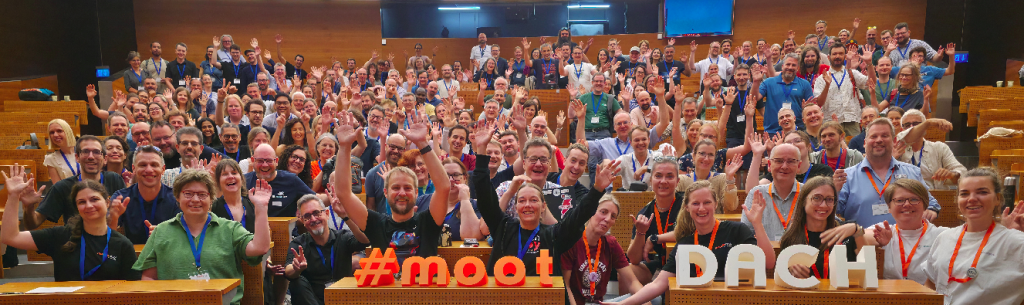
I attended with my collegue from Catalyst-EU Mark Johnson. The 2026 event took place over 4 very hot days at ETH university in Zurich. There were a total of 309 attendees, with the majority from outside the German speaking countries. Moodle HQ also sent a large delegation.
Although organised by German-speaking countries the default language is English but announcements are translated in an ultra smooth manner. Moodle is a community movement as much as it is a software product. Although most Moodle code comes from Moodle HQ, every real world installation includes 3rd party plugins, most of which are freely downloadable. There are currently well over 500 million Moodle accounts globally (see stats.moodle.org).
The magic of Unconference
It is an “unconference”, which means the topics and running order are decided at the start of each two day block, which are DevCamp and BarCamp. The organisers create a framework and after that it is “self organising”. It is one of those things like Wikipedia, in theory it cannot work but in practice it works brilliantly.
DevCamp
The first two days are DevCamp which aims to create new working code and ideally have plugins ready to use by close of play. If you are running Moodle you are very likely to have a plugin that started life at MoodleMootDACH. People queue up to “pitch ideas”, and people form into teams of around 5 and work furiously to plan and build their projects.
At a time when the answer to every question in EdTech seems to be “more AI” there were only about 3 projects out of about 25 that were explicitly about using it, though I suspect most teams used AI to help generate code.
I find the atmosphere during development very special. To be in the room with smart people focussing, exchanging messages and occasionally chatting about what they are working on is a delight.. It is very common for the developers to have teaching qualifications and they bring a significant student focus.
DevCamp winners!
At the end of DevCamp attendees get to vote on the following categories
This delighted me as over the last few months I had been dreaming of such an idea (is it wrong to dream of Moodle plugins?). I have been experimenting with the plugin and it looks very promising.
Improvements
The Improvements category was won by the activity Wizard, the team included Moodle founder Martin Dougiamas and I was amused to see they included their photo in the Github repo.
Globally a huge amount of effort is put into creating code and plugins with new features and capabilities and it is very good to see effort into making the existing system easier to use.
Daily helpers
The Daily helpers category was won by “Bring your support materials”
The motivation described in the README file says it all
“You have extensive support materials, but you’re not sure if your users can find them? Wouldn’t it make sense to integrate them directly into Moodle? With moodle-tool_sherpa, external links to Moodle help texts can be added to simplify access and increase the visibility of these materials.”
BarCamp
BarCamp is aimed at non developers, although running immediately after Dev Camp means plenty of developers stay on.
There were 49 BarCamp sessions with a strong theme of Assessment, Grading and Engagement with an emphasis on quizzes, question banks and evaluation tools.
One of my favourite sessions was by Alexander Bias presenting MDLShield https://mdlshield.com. This is a cloud service that checks plugins for security and other issues. Although it uses AI, it is created by people with a very strong background in Moodle and goes far beyond what any generic security or AI tool can do.
Marketplace
Rosa Viera de Almeida from HQ gave the presentation “From plugins directory to Moodle Marketplace”. This is a “Big Deal” (™). The place of money in an Open Source project like Moodle will always trigger debate. But it seems reasonable to offer ways for developers to make money from their efforts.
The 15 year old plugins database is now read only and is due to be replaced by the Marketplace on Monday 20 July 2026. I found a lively discussion on this topic dating back to 2015 and the idea has been debated extensively over the years. Marketplace will accept free plugins but there will be the option for paid plugins using the Stripe payment service.
The Q&A section of the presentation resulted in some lively discussions which have continued in various forums since the event.
Martin Dougiamas: Starting over
Martin Dougiamas, founder of the Moodle project gave a session that was effectively a keynote. Although he ranged over some wide philosophical areas linking technology and education, I was struck by his comments on using local AI.
“This presentation right now is like I said I made it with my voice talking to my assistant which is an open‑source AI model running on a laptop in my house and I’m connected over a VPN right now and m y personal assistant that I’ve been building most of this year is completely local – it’s completely running all the memory, all of the AI, everything is running local. ….”
“Because I can trust it, trust is the number one thing with AI, I give it more of my data. I love giving it data. I’m on chat sometimes just telling it what I’m doing – I’m doing this now, I’m doing that now, I’m doing this and it remembers everything.”
Wrap up …
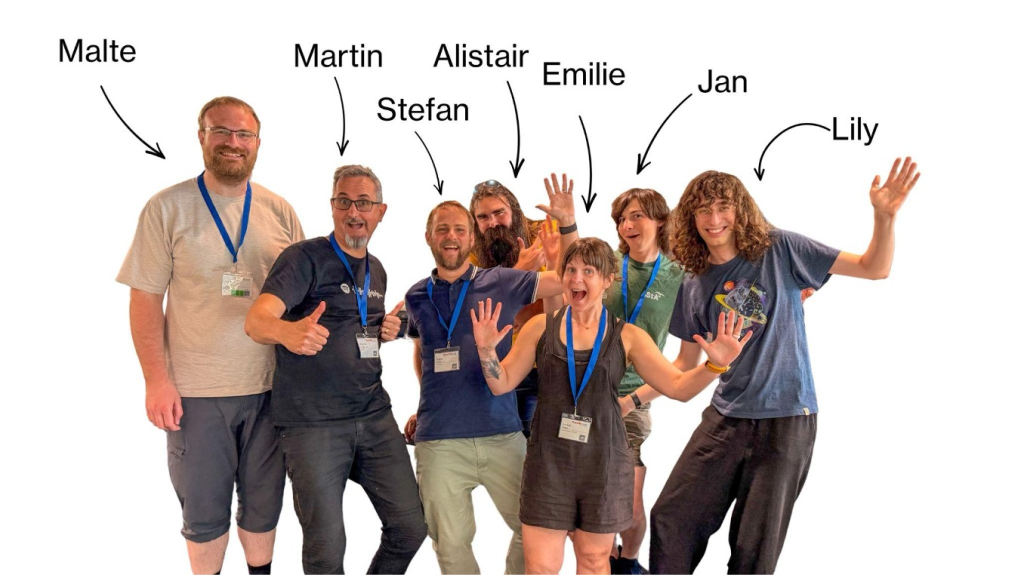
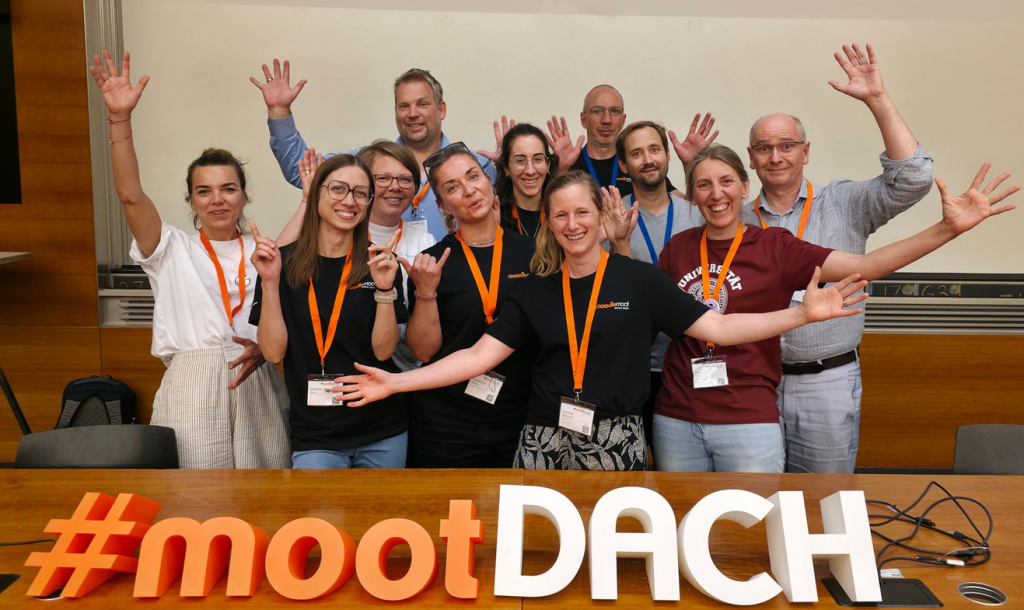
These are the main organisers and I am in awe of their ability to make a complex multilingual conference run so smoothly and keep a positive outlook throughout.
I am already looking forward to MoodleMootDACH27 in Vienna, Austria. I have told myself that next year I will at least be able to introduce myself and the topic of any presentation in German…but I said that last year.
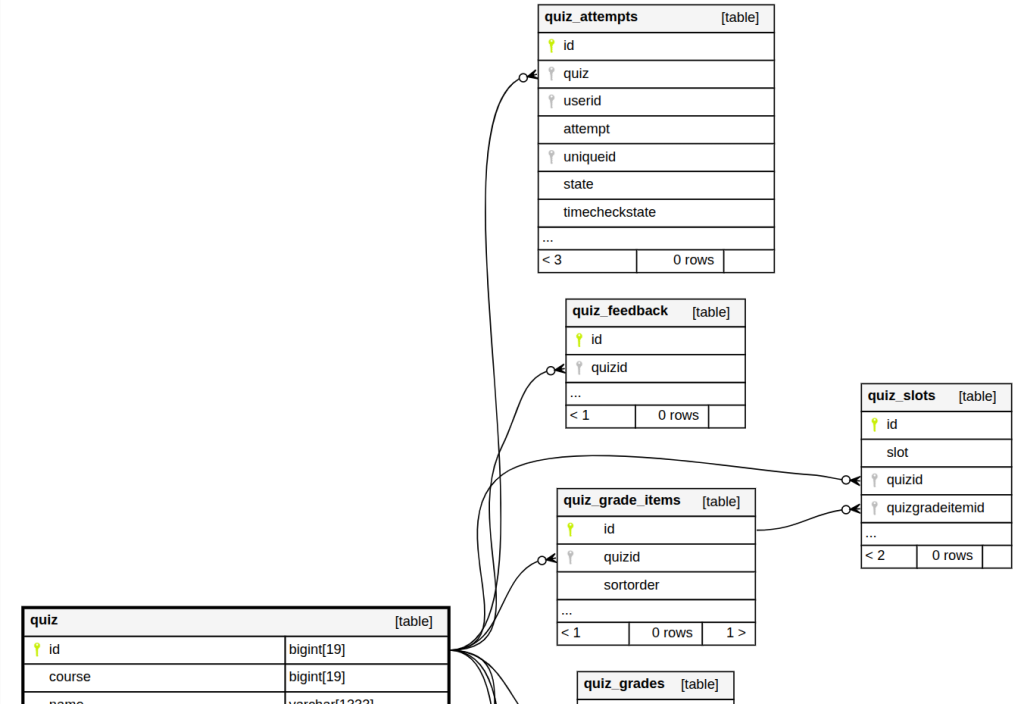
I am interested in learning analytics and tools for querying Moodle data and the first step is to understand how the data is structured.
You might think that documenting the database would be a trivial activity, but due to mainly historical reasons it is fairly complex. A fresh install with no plugins creates around 500 tables. The relationships between tables are discarded during the installation process. There is no database level referential integrity, it is all done at the application level.
This means you cannot use a standard database tool to use those relationships when creating queries. My process restores those relationships in the documentation which is helpful for query building..
In addition to processing the data in the Moodle installation files I add approximatly 70 additional implied table relationships and links to sources for database queries in the Moodle documentation.
You can see the ER diagrams by scrolling to the end of any of the table pages, This is part of the diagram for the core quiz module.
The tools and techniques I have used over that time have changed and evolved and since 2014 I have maintained a custom plugin to help with the task. I have had various ideas for improving on this plugin over the years but have done little to it due to time constraints.
The arrival of LLM/AI assisted development has allowed me to make improvements in the latest version. The changes have taken a small number of days to complete and without AI it would have taken a small number of weeks.
It now includes the ability to extract the default data from a fresh install and create a file describing that data. For each table that includes this type of data there is now a link to it. The whole file set can be downloaded for local use and there is a link to the current and archive file here
This version includes a link at the top called Changelog which describes what has changed since the last Moodle release.
I am currently investigating how to use the database structure information and an external AI/LLM system to make it easier to create queries and Moodle reports.
A MoodleMoot is a chance to learn what is happening in the world of Moodle and to meet the people doing it. MoodleMoot Estonia in April did an excellent job on both counts. Tickets were €200 and I have jokingly said that I ate that value in delicious food during the intervals. I know we are supposed to treat conference food as secondary, but it really was spectacular.
Tallinn, the capital of Estonia is a beautiful medieval city close to the sea, it is clean, affordable, has good public transport and people speak excellent English. My main takeaway from the event is that in much of Europe the open source is the default assumption in selecting technology. Historically price was often the first consideration, but privacy, security, data sovereignty have become more important.
Taltech University
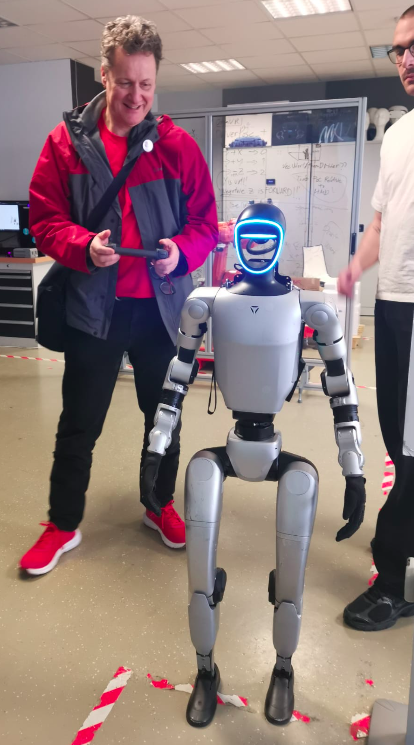
Before the first day of the conference I went on an organised visit to TalTech the Technical University of Estonia. The highlight of that visit was being allowed to control industrial Robots. I have seen them many times on video but it is quite eerie to actually take control of one and to be reminded of their capabilities and that they are clearly going to be a part of everyday life.
Welcoming my new robot overlord
The theme of the event was “Creativity and Collaboration in the Age of AI” and I was delighted that there was both optimism and caution in the coverage of AI.
Keynote from Marie Achour
I will concentrate on the keynote on the first day from Marie Achour, Chief Product Officer at Moodle HQ. She is closer to the decision making than just about anyone so is a good indication of the likely future direction of all things Moodle. She gave credit to the importance of contributions from the community and a summary of the new features of Moodle 5.2 including the first elements of the Blind marking project, for which Catalyst-EU who I work for were contributors. She gave some hard data on the amount of code committed to core Moodle from the community, illustrating that the idea of “the community” is not just lip service, it is real functionality. Disclaimer…. I contributed a small amount of code to the 5.2 release.
She headlined three areas of focus for Moodle, ease of use, ease of upgrade and the all encompassing improving learning outcomes. I liked her quote from user feedback.
“Moodle’s a bit too hard to use. It is so rich in functionality that that richness has an offset that makes it a little harder than it should be once in a while.” Nobody ever said that Moodle was lacking in features but the complexity can be overwhelming so I was pleased to see that is a priority.
Ease of upgrading is an odd thing because so few people see it or get to feel the benefit. There have been significant changes since Moodle 5.1 and 5.2 which promise good things in the future both for ease of upgrade and making it easier to keep a site secure (very topical in the week I am writing this)
A headline for the improving learning part of the presentation was that AI is important but it must remain optional. Because many places where Moodle is used without access to AI, and even without Internet access, Moodle AI should stay optional. I have a personal interest in this as I am a fan of MoodleBox, which is Moodle on a Raspberry PI which has very low power requirements and is widely used in places with no internet. For me It is essential that it works without access to AI and Moodle HQ takes the same view.
Marie then went on to explain the “AI, your way” as a founding principle. Each Moodle installation gets to select what external AI/LLM service they want to use including the possibility of a self hosted system so no data ever leaves your own network. They have been recording how educators actually use Moodle and that will inform changes to use AI to save time and there is a plan to add features that will use AI to create course content.
The rest of the Moot
I follow Moodle development very closely and I came away from the keynote feeling optimistic. Issues that have been spoken about for a very long time are being addressed in an incremental and professional way. Apart from Marie’s presentation I particularly enjoyed Heikki Willneus talking about his academic research into the use of AI in education particularly how there is no clear evidence how AI affects learning outcomes. I was more interested in the idea that AI can reduce teacher workload, though I am always suspicious it will result in teachers being given more work to do. On day two Adam Jenkins (who came from Japan for the event) gave a very engaging presentation on the importance of keeping your moodle version up to date, for security as much as features.
There were over 200 attendees, 31 presenters and I have only touched on a few of them. There was enough to keep me thinking for many, many months If you are in that part of the world (or just like that part of the world) there is a MoodleMoot Nordic happening in September (primary language English) which you can read about here
I would like to thank the organisers, Moodle Partners #Vextur, for allowing me to present at MoodleMoot Estonia and I will post about that at a later date.
I am doing a joint presentation of my AIText question type with Joseph Thibult of Cursive Technologies. It is on Wed 19 November 2025 at 8AM EST/1pm GMT, read more about it here.
At MoodleMootDach25 there was a meeting to organise Online Community meetings to continue the collaborative spirit of the Moodle Users Association meetings.
Harald Schnurbusch and Don Hinkleman reached out to interested people and a format was agreed to base the topics mainly on recent MoodleMoots around the world, but the meetings can be about anything of interest to Moodle users.
The next meeting: Tuesday, November 25, 2025, 12:50 PM (GMT) I will give a presentation that covers the MoodleMootGlobal25 held in September in Edinburgh. I have been going through the videos posted on Youtube and will give a breakdown of some of the main topics covered. This is a link to the meeting
I gave a presentation about my AI Text question type as part of the keynote address at MoodleMoot Global in Edinburgh in September. AIText is a Moodle question type that uses an external LLM (e.g. ChatGPT) to give automated feedback to free text question responses.
You can see the presentation here
The keynote was opened by Moodle CEO Scott Anderberg, and followed and I followed on from Peter Mayer of Mebis. This was appropriate as Peter and his team have made significant code contributions to AIText and have deployed it to large numbers of users. I received a lot of good feedback especially where I advised caution about the limitations and risks of using LLM systems.
5.1 folder structure troubles
Moodle 5.1 introduced a new organisation of the Moodle file structure where a some of the files are outside/above the publicly visible area and most of the files are in a folder called public. You can see this at in the github repo here
In summary, this is a signficant change so make sure you understand what is necessary and do practice runs before upgrading to Moodle 5.1.
Moodle 5.1 AI features
Moodle 5.1 allows Core AI Features to be enabled/disabled at the course or activity level. This will work for activities that know nothing about the AI Subsystem.
I have been doing Moodle development using the https://opencode.ai cli LLM assisted development tool with https://openrouter.ai for price competitive inference A key component of this is https://github.com/wilenius/momopda from Heikki Wilenius. This consists of a set of prompts that ensures the LLM is initialised with Moodle development guidlines.
This has given me a significant productivity boost.
I am writing this from Lubeck Germany ready for the start of MoodleDach “unconference” starting tomorrow 2nd September 2025. I have been twice before and the unconference concept means that the schedule is decided on the first day. This has been very effective in the past and the related discussion forum is starting to fill with ideas as to what should be covered.
MoodleDach is developer focussed and in previous years people have developed new plugins from concept to plugins database over the event.
I will be attending, and I will have my guitar with me…
Improvements in Core AI
The core Moodle AI Subsystem now has more meaningful error messages. Previously whenever there was an error the user would see a generic
“ Something went wrong”
Try again later
https://moodle.atlassian.net/browse/MDL-83147
Question Generation
The people at ByCS Lernplattform (formerly Mebis) have done a huge update to the questiongen plugin. It is configurable to work with 3rd party question types and can even pull in text from pdf’s as the source for generating questions.
I opened an account with Together AI and spent US$5 (five) worth of tokens. After quite a lot of experimenting it is currently costing me on average 1 US$ cent per day.
I have attached one of my moodle sites to Google Gemini using the ByCS local_ai_manager and I am impressed with the results.
AI for teaching programming
I have tweaked my AI Text question type to process questions relating to programming languages and have found the Qwen models particularly effective.
Bulk Tags AI Suggestions
I have added an “AI Suggestions” feature to my Question bank bulk tagging plugin. This currently only works with Moodle 5.0 but I can retrofit it for Moodle 4.5 if anyone wants it badly enough.
If you want to follow discussions about the Core Moodle AI Subsystem there is a forum at moodle.org here
https://moodle.org/mod/forum/view.php?id=8826
However it does seem rather quiet.
I recommend the AI Lounge here
https://moodle.org/mod/forum/view.php?id=8776
Which contains summaries of the biweekly meetings chaired by Martin Dougiamas and is a really useful source of up to date information.
Moodle AI Plugins
I have been gathering a list of Moodle plugins that use AI/LLM systems that do not require a subscription to the provider of the plugin (though of course they all require access to an LLM. You can find the list at the end of this page.
The next version of Moodle is scheduled for release on 6 October 2025 and is currently in QA. These items caught my eye on Jira
AI: Add user access controls at course and activity level
https://moodle.atlassian.net/browse/MDL-85738
Allow teachers to specify AI access per activity (e.g., disable “generate text” in a particular quiz) rather than at a broader level.
Let site admins set default AI settings that can be locked or overridden at the course level.
Allow report builder schedule types to be easily extended
https://moodle.atlassian.net/browse/MDL-86066
Restructure moodle code directories
https://moodle.atlassian.net/browse/MDL-83424
A Moodle Gemini provider
I have not tried it yet but … according to the page at moodle org
“A Moodle AI provider plugin that integrates Google’s Gemini AI models into Moodle’s AI subsystem. Supports text generation, image generation, and text summarization with configurable rate limiting and privacy-first design.”
https://moodle.org/plugins/aiprovider_gemini
AIText
The updates and features in the next release can be seen here
I will be including an “expert mode”, which will give people experienced with prompt creation more control over what is sent to the external AI.
In a recent conversation I discovered an organisation that looks after the Moodle setup in 23 universities is testing my AI Text question type with a view to deployment.
I am hoping that more people using it will result in more ideas for prompting.
Canvas and OpenAI in partnership
Instructure and OpenAI (makers of ChatGPT) have announced a Global Partnership to Embed AI Learning Experiences within Canvas.